LinkedIn is where people put their professional lives on display, so it's natural to start there when you need to reach someone by email. Even so, LinkedIn keeps email addresses behind connections and privacy settings. This guide shows where an email can appear on a profile, who can see it, and four reliable ways to find a professional address when LinkedIn doesn't show one, plus how to use it without landing in spam or breaking the rules.
Check 5,000+ social, dating and gaming sites in seconds. No signup.
Who can see an email on LinkedIn
Every LinkedIn member has a Contact info section. It always shows their profile link, and it can also show an email, a phone number, websites and a birthday. However, whether you see the email depends on two things: how you're connected, and what the member allows.
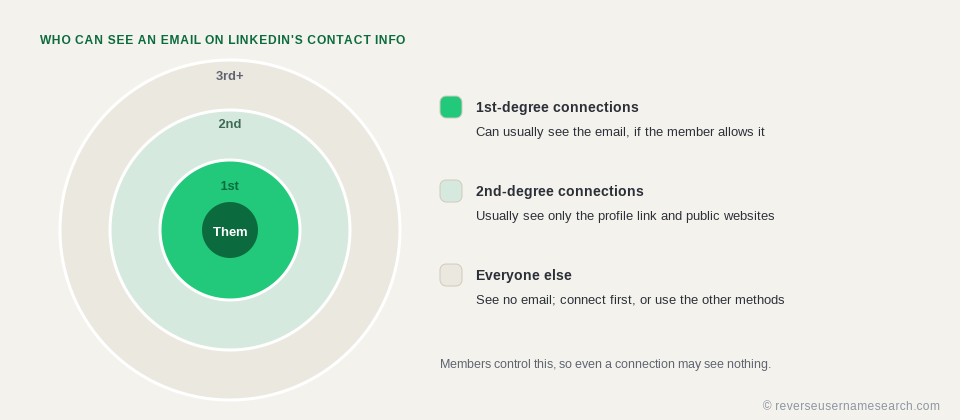
In practice, 1st-degree connections usually see the email, unless the member has turned that off in their privacy settings. Everyone else typically sees no email at all. So, if you're not connected, Contact info will almost never give you an address, and you'll need one of the other methods.
Method 1: Check Contact info on their profile
Start with the obvious place, because it takes ten seconds. Open the person's profile on a computer or in the app, and click Contact info under their name and headline.
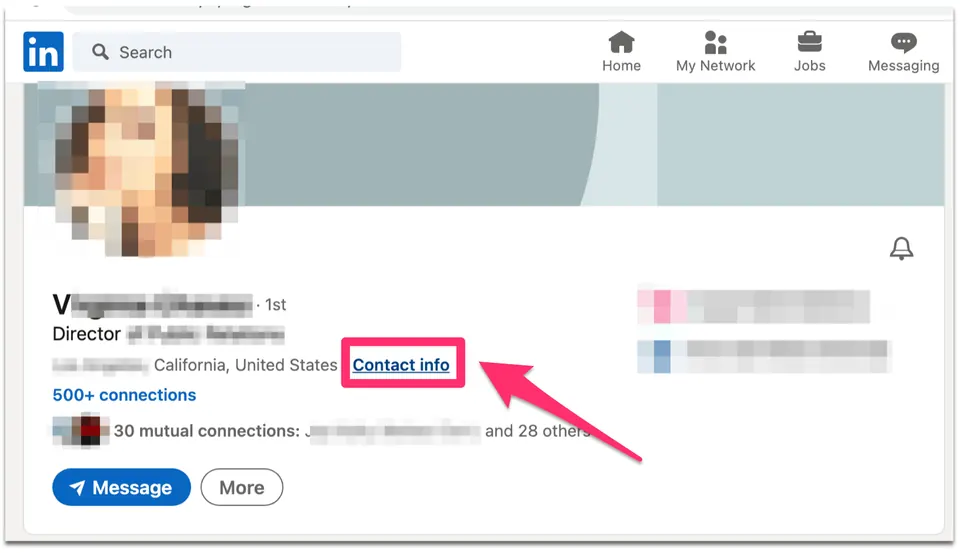
A window opens with whatever the person shares with you. For a 1st-degree connection, that's often a personal or work email, and sometimes a phone number and other profiles.
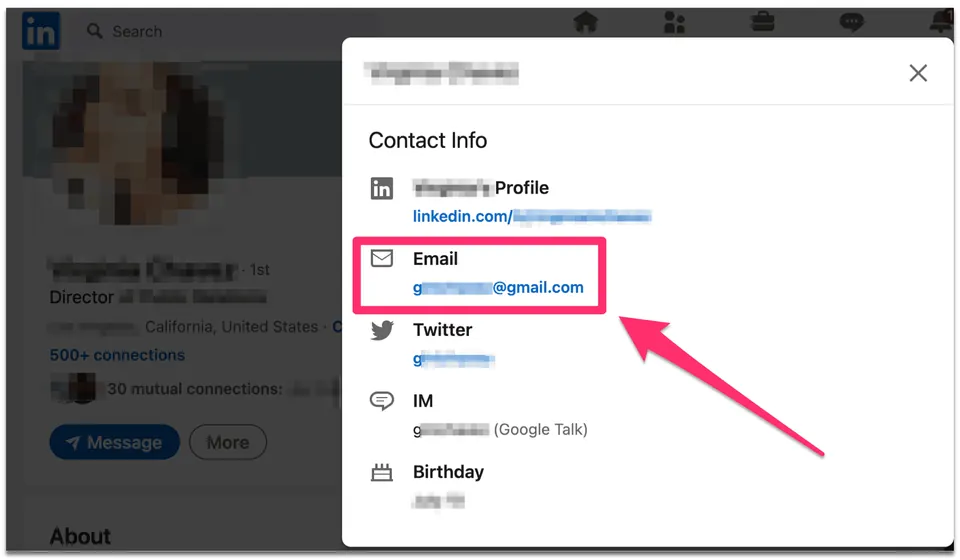
If you aren't connected, send a connection request with a short note explaining why. Once they accept, check Contact info again. Even if the email is still hidden, you can now message them directly, which often works better than email anyway.
Method 2: Look for the email elsewhere on their profile
People who want to be contacted often put an address where everyone can see it, outside Contact info. Read these parts of the profile carefully.
The About section. Freelancers, recruiters, consultants and salespeople often end their About text with an email or a line like "reach me at…". Some write it with spaces or "at" and "dot" to avoid spam bots.
Featured links and websites. A personal site, portfolio or company page linked from the profile usually has a contact page with an email.
Posts and articles. People who publish on LinkedIn sometimes add contact details at the end of a post, especially when they're hiring or promoting an event.
The headline. It's rare, but some consultants include a short address or a website right in their headline.
Method 3: Work out their company's email format
For a work email, the company's naming pattern is often the fastest route. LinkedIn shows the person's current employer and their full name, and most companies build every address from the same pattern.
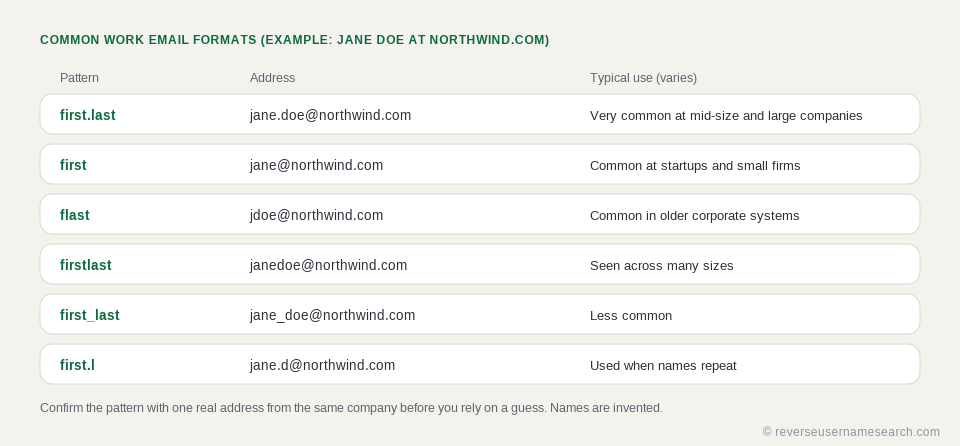
First, find one real address from the same company. Press releases, the company's contact page, conference speaker lists and job postings often include a named employee's email. Next, apply the same pattern to your person's name. Then, check the result before you rely on it.
To confirm a guess, search the full address in quotes on Google. If it appears on any page, you're likely right. Free email verification services can also check whether an address accepts mail, although some company servers accept every address, which makes those checks less reliable.
Watch for edge cases. People with hyphenated names, nicknames or common names may get a variation, such as an added middle initial. When in doubt, send a short message through LinkedIn instead of guessing.
Method 4: Search their name and username outside LinkedIn
Many professionals publish an email somewhere else: a personal website, a GitHub profile, a speaker bio, a podcast page or an old blog. Search their full name in quotes on Google with their company or job title, for example "Jane Doe" Northwind or "Jane Doe" "product manager".
Their LinkedIn URL often contains a username too, such as linkedin.com/in/janedoe-design. Type that handle into the search box on this page to check thousands of sites at once. A matching GitHub, Behance or personal blog often lists a contact email, and developer profiles in particular are a good source.
Their LinkedIn photo can help as well. A reverse image search can lead to a personal site or speaker page with contact details. Our guide on how to find someone with a picture shows how.
Method 5: Export your own connections' emails
If the person is already one of your connections, LinkedIn can give you their email in a spreadsheet, along with everyone else's. Go to your settings, open the data privacy section and request a copy of your data, choosing Connections. LinkedIn emails you a download link, usually within minutes for this file.
The file lists each connection's name, company, position and the date you connected. Its email column is filled only for connections who allow their connections to download their address, so expect gaps. Still, it's the quickest way to recover a contact you lost, for example after changing jobs or phones.
Keep that file private. It holds other people's personal data, so don't upload it to mailing tools or share it, and delete it when you're done.
Work email or personal email?
The method you choose often decides which kind of address you get, and the two serve different purposes. A work email reaches someone in their professional role, so it fits job inquiries, partnerships and business questions. It also stops working the day they leave the company, which LinkedIn will show you once they update their profile.
A personal email lasts longer and suits reconnecting with an old colleague or friend. However, people guard personal addresses more closely, and a business pitch sent to one can feel intrusive. As a rule, use the address that matches why you're writing, and if you only have the "wrong" one, say briefly how you found it.
Common mistakes to avoid
A few habits cost people replies, or worse. Avoid these and your search will go faster and land better.
Guesses sent without checking. An unconfirmed address bounces or reaches the wrong person. One Google search for the address in quotes usually settles it.
An old employer's domain. LinkedIn profiles aren't always current, so check the person's latest posts or activity before you use a company format.
Mass messages. A template sent to dozens of people reads like one, and spam filters agree. Write each first email yourself.
Too much at once. An email, a connection request, an InMail and a follow-up on the same day feels like pressure. Pick one channel, wait a few days, then follow up once.
Email finder tools and people search: what to know
Sales teams use email finder tools that guess and verify work addresses from a name and company. They're quick, and many offer a small number of free searches each month. On the other hand, they mostly find work emails at companies with public domains, and their guesses still need checking.
People search services, such as Trustiko, take a different approach. They match a name against public records and can show possible personal emails and phone numbers. Use them for reconnecting with someone or confirming identity, not for marketing, and treat any address as a lead, because records can be out of date.
Be careful with browser extensions that scrape LinkedIn profiles. LinkedIn's user agreement prohibits scraping, and accounts that use these tools can be restricted. In short, the manual methods above are slower but safer.
If they changed jobs recently
A job change is the most common reason an email on LinkedIn stops working. The old company deletes the address, often within days, and messages bounce or vanish. So, before you email a work address, check the person's Experience section and recent activity to confirm where they work now.
When someone has just moved, their new company's email format may still be guessable, but the address may not exist yet in public anywhere to confirm it. In that case, a LinkedIn message or a connection request is the better first step. People are usually responsive right after a move, because they're building their new network.
If you're trying to reach someone who has left the workforce or gone freelance, look for a personal website or portfolio linked from their profile. Freelancers nearly always publish a way to contact them, because that's how they get work.
Which method should you use?
| Situation | Best method | Why |
|---|---|---|
| You're already connected | Contact info | Shows their chosen email in seconds |
| Freelancer or consultant | About section and website | They usually publish an address to get work |
| Employee at a known company | Company email format | One real address reveals the pattern |
| Developer, designer or writer | Username search | GitHub, Behance and blogs often list emails |
| Old friend or former colleague | Connect and message | A short note gets a reply more often than cold email |
A worked example: reaching a hiring manager
Here's how the methods combine in a typical case (the names are invented). Alex wants to send a short note to Priya Shah, an engineering manager at a mid-size company called Northwind, about an open role.
First, Contact info. Alex isn't connected to Priya, so Contact info shows only her profile link. Her About section has no email either.
Next, the format. On Northwind's newsroom page, Alex finds a press contact, tom.baker@northwind.com. The pattern is first.last, so Priya's address is likely priya.shah@northwind.com.
Then, the check. A Google search for the address in quotes finds it on a conference agenda where Priya spoke last year. Now Alex knows it's right.
The outcome. Alex sends a four-sentence email that mentions the specific role and a project from Priya's conference talk, and also sends a connection request with a short note. Priya replies to the email two days later. The search took about ten minutes, and the conference page did the real work.
How to email someone you found on LinkedIn
The address is half the job, and getting a reply is the other half. Keep the first email short: who you are, why you're writing to them specifically, and one clear question. Mention something real from their profile or work, such as a post, a project or a talk, so it's obvious you aren't sending a mass message.
Respect the rules, too. In the US, commercial emails must follow the CAN-SPAM Act, which requires an honest subject line, your physical address and a working way to opt out. Meanwhile, in the EU and UK, data protection law limits how you can use personal data, including email addresses, for marketing. If someone doesn't reply after one polite follow-up, let it go.
Keep your own email private on LinkedIn
Everything above also works in reverse. If you'd rather not share your email, open LinkedIn's settings, go to the visibility section and choose who can see your email address. Some people set it to "only you" and rely on LinkedIn messages instead.
Also think about what's on your profile beyond Contact info. An email in your About section or on a linked website is visible to everyone, including spammers. A contact form on your website gives people a way to reach you without exposing the address itself.
Frequently asked questions
Can you see someone's email on LinkedIn?
Sometimes. Open their profile and click Contact info. If you're a 1st-degree connection and they allow it, their email appears there. Strangers usually see no email at all.
How do I find an email on LinkedIn if we're not connected?
Check their About section, featured links and website for an address. For a work email, find the company's email format from one real address and apply it to their name, then confirm it with a Google search. You can also send a connection request and message them.
Does LinkedIn Premium show email addresses?
Premium lets you message people you aren't connected to through InMail, but it doesn't reveal email addresses that a member keeps private. The same privacy settings apply.
Is it legal to email someone I found on LinkedIn?
A personal, relevant email is generally fine. Commercial emails must follow laws such as the CAN-SPAM Act in the US, and data protection rules in the EU and UK limit using addresses for marketing. Note that scraping LinkedIn also breaks its user agreement.
How do I hide my email on LinkedIn?
Open LinkedIn's settings, go to the visibility section and choose who can see your email address. Also remove any email from your About section and headline, since those are visible to everyone.