Instagram Username Search
Free Instagram username search. Check an Instagram handle, find the same username on 5,000+ sites, and use the clues to see who is behind the account.

Trace a fake or anonymous Instagram account back to the person behind it, and report it if it's impersonating you.
Instagram's result is pinned at the top. The other 5,000+ sites show where the same username is used, often by the real person behind the fake account.
Can you find out who made a fake Instagram account? Instagram won't tell you, but the account often gives its owner away. The most reliable clues are the username, which people reuse on their real accounts; the profile photos, which a reverse image search can trace; About this account, which shows when the account joined and how often its username changed; and the account's first follows and mutual followers, because fake accounts often start inside the creator's own circle.
Fake accounts are built quickly, and quick work leaves clues. This guide walks through six steps, from the fastest checks to the slowest, then shows you how to weigh what you find so you don't accuse the wrong person. It also covers what to do if the account is pretending to be you, or if it's being used to harass or threaten you.
Not every fake account is made by the same kind of person, and that changes where you should look. A scam team in another country leaves very different clues from a classmate with a grudge. So, start by asking which kind you're dealing with.
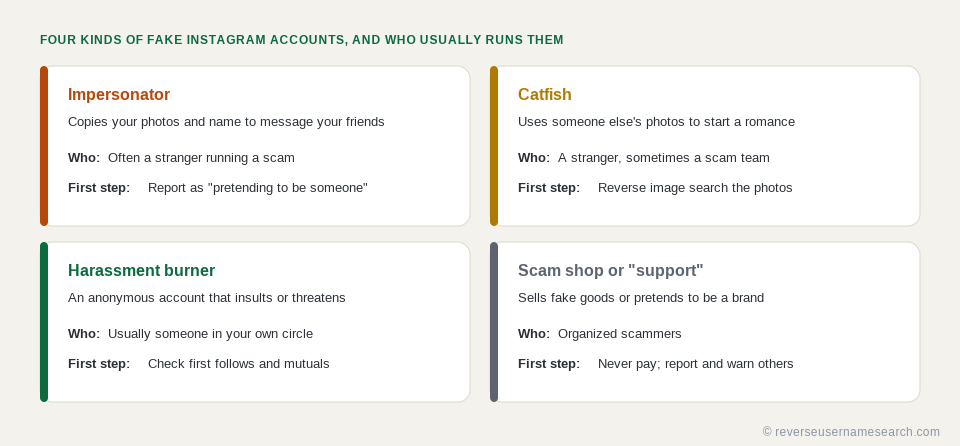
The difference matters. Impersonators and scam accounts are usually run by strangers, so the goal is to report and warn, not to unmask. Harassment burners are the opposite: they target one person or one group, so the creator is usually someone who knows them. That's where the steps below work best, because the creator's real life leaks into the fake account.
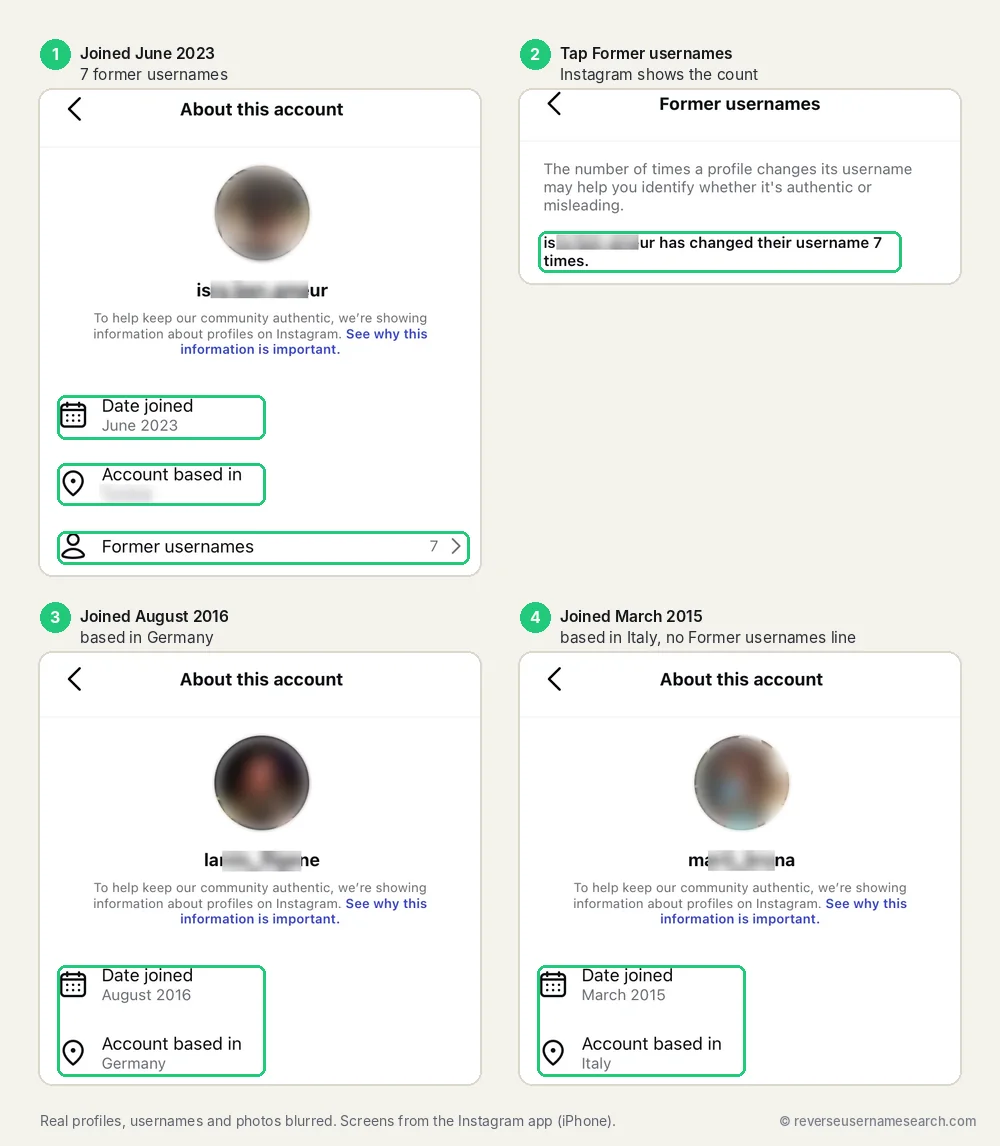
First, open the profile, tap the three dots in the top right corner and choose About this account. Instagram shows up to three facts, and each one is a clue.
Date joined. An account created last week that claims to be someone you've known for years is a red flag. For a burner account, the date can also line up with an event, such as an argument or a breakup, which narrows down who had a reason to make it.
Account based in. The country the account is run from. So, if it says a different country from where the person supposedly lives, be suspicious, and if it says your own country for an "overseas" profile, note that as well.
Former usernames. How many times the username changed. Fake and scam accounts often rename several times. Write down every username you can see, because old usernames are often closer to the creator's real handle.
Type the username into the search box at the top of this page. We check Instagram and thousands of other sites. People who create a fake account in a hurry often reuse a handle, or a variation of one, that they already use on TikTok, Snapchat, Reddit, gaming sites or an email address.
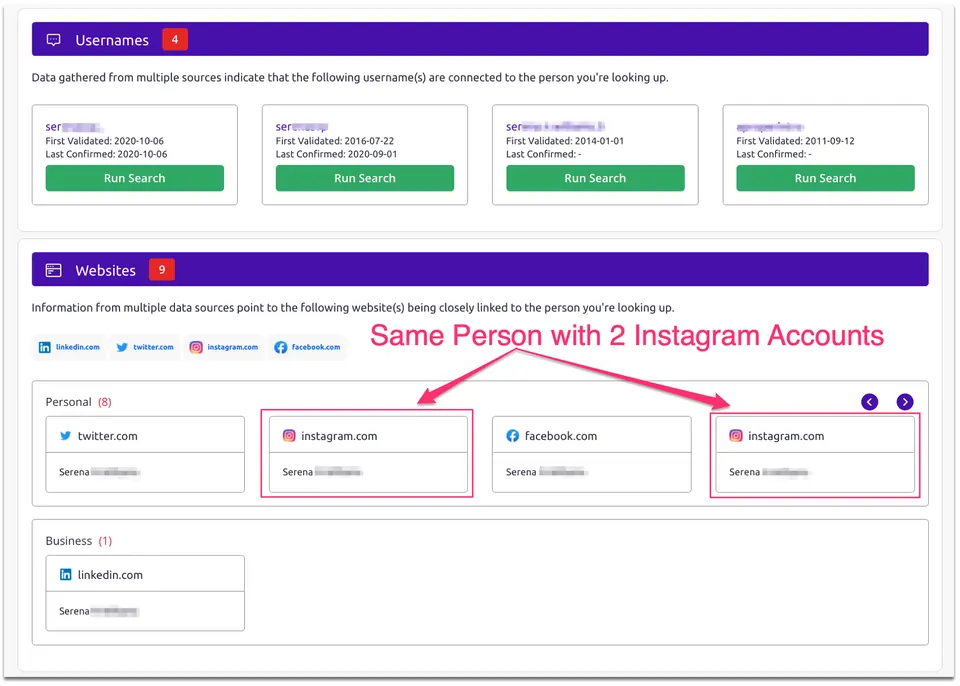
Also, for a second opinion, try Profile Who Is, a free username identification tool that shows who may be behind a social media handle. Type the exact username into its search box and wait for the scan; it can show details about the user and their other accounts on social media and dating sites.
Don't expect a perfect match every time. A careful creator picks a brand-new handle. Still, even careful people slip when they rename an account later, and that old name is often the one that links back to them.
Most fake accounts use stolen pictures. Save the profile photo and a few post images, then search them with Google Lens, Bing Visual Search or TinEye. You'll usually find one of two things.
The real owner of the photos. That proves the account is fake and tells you who's being impersonated. If it's someone you know, warn them, because their friends may be the next targets.
The same photos on another account run by the same person, sometimes with their real name. Burner accounts often reuse a meme, a screenshot or a background photo that the creator also posted somewhere else.
Look beyond faces, too. A photo of a street, a room or a school hallway can show where the creator lives. Our guide on how to find someone with a picture shows each tool step by step.
A new fake account has to start somewhere. That's why creators usually follow people they know: friends, classmates, coworkers, an ex. If the lists are visible, three patterns are worth looking for.
The first accounts it followed. On many accounts, the oldest follows sit at the bottom of the Following list. A creator often follows their own friends, or even their own main account, before they think about hiding it.
Mutual followers you share with it. If all of them come from one school, team or workplace, the creator is probably in that group too.
Who it interacts with. Likes, comments and story replies aimed at a small group of people show whose attention the creator wants. In fact, a burner account that only ever comments on one person's posts is rarely a stranger.
Creators often forget how much an account's extras reveal. Read the bio slowly for slang, a nickname, an emoji or an inside joke. Then tap every link. A link page, a TikTok, a Threads badge or a Facebook link under the bio each lead to another account, and secondary accounts are often less careful than the fake one.
Also check where the account appears. Search its username in quotes on Google, and look for comments it left on public posts. A burner account that once replied to its creator's real account, or tagged a friend, has already given you a thread to pull. Our Instagram username search guide shows real examples of how much a bio and its links can reveal.
People give themselves away in small habits, so compare the fake account with the people you suspect.
None of this is proof on its own. Together, though, these clues can point clearly to one person, especially when they agree with what you found in the first five steps.
This is the step most people skip, and it's the one that prevents painful mistakes. Clues aren't equal. Some are close to proof; others only fit a story you already believe.
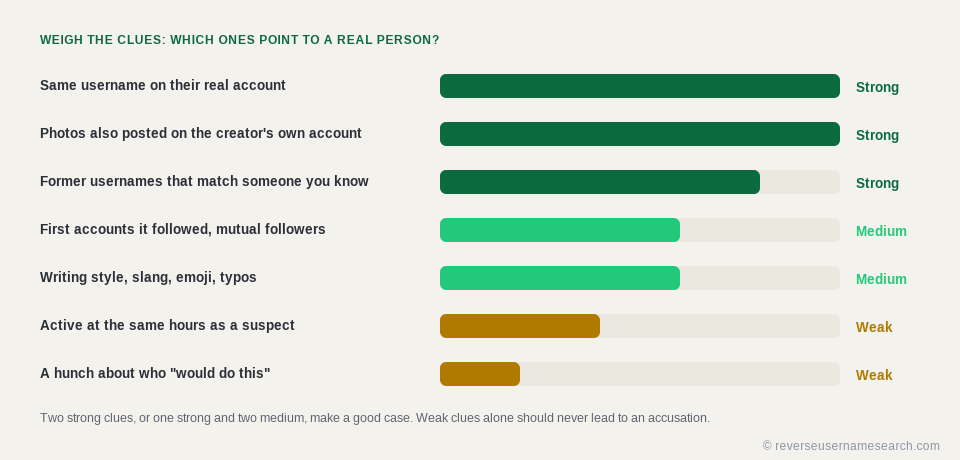
Strong clues connect the fake account directly to a real one: the same handle, the same photos or a former username that belongs to someone you know. Medium clues, such as mutual followers and writing habits, narrow down a group. Weak clues, like being online at the same time, fit almost anyone.
So, before you confront anyone, ask yourself whether you have two strong clues, or one strong and two medium. If not, keep collecting, or hand what you have to someone with more authority, such as a school, an employer or the police. A wrong accusation can do real harm, and it warns the real creator.
For instance, here's a typical case (we invented the names). Over a week, an account called truth.about.jess_ posts mocking comments under Jess's photos and sends her nasty messages. The profile has no picture and four posts, all screenshots of Jess's own stories.
First, About this account. The account joined three weeks earlier, the day after a falling-out in Jess's friend group. It also shows two former usernames. Jess's mom notes both of them down.
Next, the usernames. The current handle finds nothing elsewhere. However, one former username, mxrie.edits, turns up on TikTok, where it belongs to an account that posts video edits. Moreover, that TikTok follows several of Jess's classmates.
Then, the follows. The fake Instagram account's first follows are five students from Jess's class, and the screenshots it posted came from Jess's Close Friends story, which only twelve people can see.
The verdict. A former username linked to a real account, a narrow group who could see the stories, and timing that matches the falling-out: two strong clues and two medium ones. Jess's mom doesn't confront the girl herself. Instead, she takes screenshots, reports the account to Instagram and shares the evidence with the school, which handles it with both families.
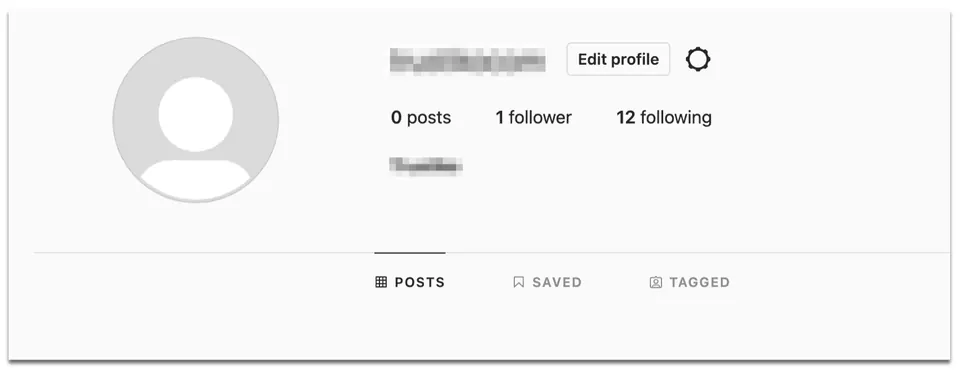
Sometimes the question isn't who made an account, but whether it's real at all. These signs appear again and again on fake profiles.
| Sign | What it often means |
|---|---|
| New account, several name changes | The strongest single sign; scam accounts rename after each round of victims |
| Few posts, model-quality photos posted on one day | Stolen pictures; a reverse image search usually finds the real owner |
| Follows thousands, followed by few | A mass-follow account looking for targets |
| Followers that are empty accounts | Bought or fake followers to look established |
| No tagged photos from real friends | Nobody in real life knows this person |
| Urgent requests for money, codes, gift cards or private photos | A scam or sextortion attempt, whatever the story |
One sign alone proves little, because some real people post rarely or keep few followers. On the other hand, three or four together almost always mean a fake.
An account using your photos and name can damage your reputation and trick your friends, so act quickly and in this order.
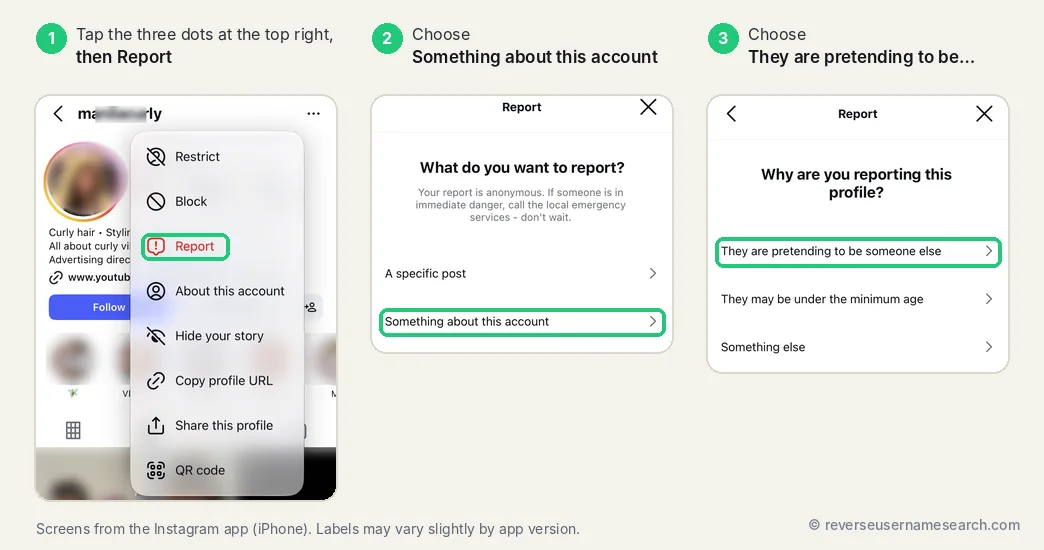
Then check whether the same person copied you elsewhere. Search your own username and run a reverse image search on your profile photo. Our guide on how to check if someone is using your identity covers the other platforms.
When a fake account crosses from annoying into harassment, threats or blackmail, your priorities change. Your safety and your evidence matter more than finding out who's behind it.
First, don't reply and don't pay, whatever the account demands. Next, save everything: screenshots with dates, usernames, links and messages. Then block and report the account in the app. If you're a student, tell a parent or a teacher; if it's about work, tell your employer.
For threats, stalking or blackmail, contact the police, because they can ask Instagram for account records through legal channels. No website can do that. In the US, USA.gov explains where to report scams and fraud. If someone threatens to share intimate images, NCMEC's free Take It Down service can help remove them for anyone under 18, and adults can use StopNCII.org.
Instagram doesn't reveal the email, phone number or IP address behind an account, and no free website can. Be wary of services that claim to, because many are scams that steal your money or your own login.
Likewise, never try to trick the person into clicking links, sharing details or revealing their location. That can break the law and Instagram's rules, and it can ruin a case the police might otherwise pursue. If the account is causing serious harm, police or a lawyer can request records through the proper process. In short, use public clues to understand what's happening, then let the right people act on it.
Often, yes, from the account's own clues. Check About this account, search the username and any former usernames on other sites, reverse search the photos and look at its first follows and mutual followers. Instagram itself won't reveal who owns an account, except to police through legal channels.
No. Instagram doesn't share an account's email, phone number or IP address with other users. Police and courts can request account records through legal channels when a crime is involved.
It shows the date the account joined, the country it's based in and, when the handle has changed, the number of former usernames. Tap the former usernames line to see the count. Instagram doesn't show this screen for every profile.
Open the profile, tap the three dots, then Report, then Something about this account, then They are pretending to be someone else. If you don't have an Instagram account, use Instagram's impersonation report form. Take screenshots first, and ask friends to report it too.
No. A username search on this page doesn't notify anyone, and Instagram doesn't show who viewed a profile. The one thing to avoid is watching their story while logged in, because Instagram lists story viewers.
Usually someone in that person's own circle, such as a classmate, a coworker or an ex. Strangers tend to run impersonation and scam accounts aimed at many people, while burner accounts that target one person rarely come from a stranger. That's why first follows, mutual followers and timing are such useful clues.
Don't reply and don't pay. Save screenshots of the profile and messages, block and report the account, and tell someone you trust. For threats, stalking or blackmail, contact the police, who can request account records from Instagram.
Free Instagram username search. Check an Instagram handle, find the same username on 5,000+ sites, and use the clues to see who is behind the account.
These are the best ways to verify and see if someone is using your identity online. Many people can steal your numbers and details.
To find a specific person through their picture, use these online search engines and get most of the reverse image lookup technologies.