
Hiring a Private Investigator to Find Someone
How private investigators find people, what they can and can't legally do, what it costs to locate someone, and how to hire a licensed PI you can trust.

Reconnect with an old friend, relative or ex-colleague using free search methods, starting with what you still remember about them.
Remember an old username, gamer tag or email address? Search it here first. People often keep the same handle for years.

If you want to find someone you lost contact with, whether it's a childhood best friend, an old coworker, a college roommate or a relative, most people still leave a trail. They keep a username for a decade, post a race result, join an alumni group or get tagged at a wedding. This guide shows you how to follow that trail step by step, from the details you already know to the free tools that search them, and how to send a first message that actually gets a reply.
People rarely disappear. Instead, the details you remember slowly stop matching the person they are today. A phone number changes, an email account gets abandoned, they move for a job, and a last name changes after a wedding. Each change breaks one search you might try.
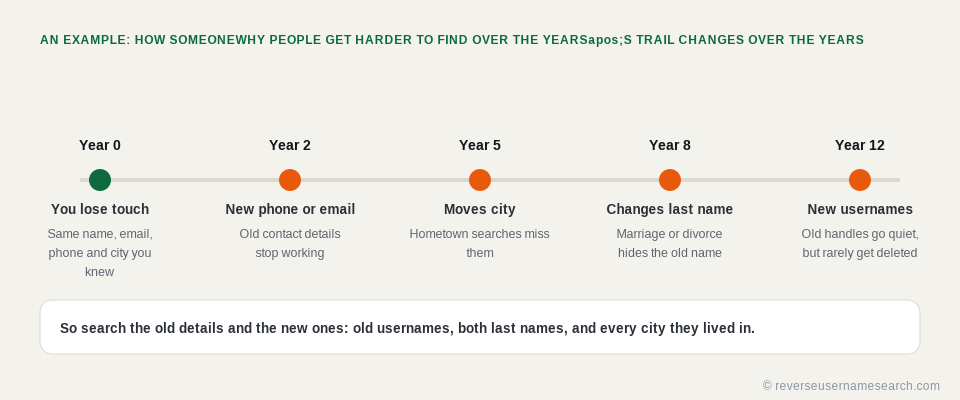
The good news is that old details rarely vanish completely. An old username stays attached to a forgotten account, a maiden name stays on an old team roster, and a hometown stays in a profile's "lived in" list. So, the trick is to search both the person you knew and the person they may have become.
Before you search, spend five minutes listing every detail. Small details are what separate your friend from hundreds of people with the same name, and you'll remember more once you start writing.
Full name, maiden or married name, nicknames, middle name, approximate age or birthday.
Old usernames, gamer tags, email addresses (even dead ones), old phone numbers, the screen name they used on chat apps.
Hometown, schools, colleges, cities they lived in or wanted to move to.
Employers, job titles, sports teams, clubs, church, hobbies, mutual friends and family members' names.
Then rank the details by how unique they are. An email like jessrunner84@… or a username is far more searchable than "Jessica Smith", because thousands of people share a name but only one person owns a handle.
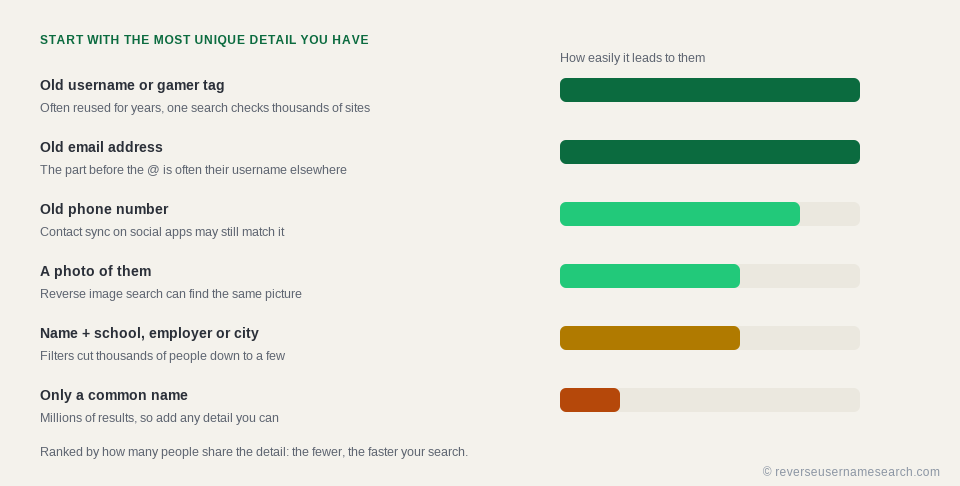
Start at the top of your ranked list. Each kind of detail has its own best free method, and the table shows where to search it.
| What you have | Best free method |
|---|---|
| An old username or gamer tag | Search it at the top of this page (for gamer tags, try our reverse gamertag lookup). We check thousands of sites at once and suggest the variations people use later, such as a birth year or an underscore. |
| An old email address | Paste it into our username search by email (we use the part before the @), and search the full address in quotes on Google. |
| An old phone number | Add it to your phone contacts, then use "find contacts" on Instagram, Facebook, WhatsApp or Telegram. Accounts linked to that number may appear. |
| A photo | Reverse image search with Google Lens, Bing Visual Search or TinEye. See how to find someone with a picture. |
| Only a name | Social media search with filters, plus Google (steps 3 and 4). |
A username is worth extra effort. People who picked a handle at 15 often keep a version of it for life, adding a year or swapping a letter when the original is taken. In fact, an old gaming or forum name can lead straight to a current Instagram or Reddit account, because people reuse what they remember.
Also try the WhatsApp check if you have an old number. Save it in your contacts and open WhatsApp: if the number is still active there, you'll see a profile photo or an About line, which tells you whether the number still belongs to your friend. Don't message yet, though; first confirm it's really them.
Social networks are where most people are easiest to find, as long as you narrow the search. A bare name search on Facebook returns hundreds of strangers, while a name plus a city or school usually returns a handful.
Facebook. Search the name, then filter people by city, education or work. Next, check the member lists of your old school's alumni groups and hometown groups, where people often join under their married name.
LinkedIn. Search the name plus a past employer or school. LinkedIn supports Boolean search, so "Jessica" AND ("Smith" OR "Brown") AND "Ohio State" covers a maiden and married name at once.
Instagram and TikTok. Search nicknames and usernames, not only real names. Also look at who your mutual friends follow, because old friends tend to follow the same people.
Mutual friends. This is often the fastest route. A short message to someone who's still in touch can save hours of searching, and it lets your friend decide whether to reconnect.
Plain searches for a common name return millions of results. Exact matches and extra details cut that down to a few pages you can actually read.
| Goal | Type this into Google |
|---|---|
| Exact full name in a city | "Jessica Smith" Columbus |
| Name plus school or employer | "Jessica Smith" "Ohio State" OR "Nationwide" |
| Maiden and married names | "Jessica Smith" OR "Jessica Brown" Columbus |
| An old username or email | "jessrunner84" |
| Name on one kind of site | "Jessica Smith" site:strava.com |
Look beyond social media in the results. Race results, company team pages, conference speaker lists, local news, wedding registries, church newsletters and alumni magazines often mention people by name, and they usually include a city or employer that confirms it's the right person.
Don't skip YouTube, either. Search their name, nickname or username, and read the comments on videos from your old school, team or hometown, where former classmates often say hello to each other.
People search engines compile public records such as past addresses, phone numbers and relatives into a single report. They're useful when social media turns up nothing, especially for people who aren't online much. You can start with Trustiko's people search, which searches by name, phone, email or username. Trustiko also offers phone and email lookups that can confirm an old contact detail still belongs to them.
Records can be outdated or mix up people with the same name, so treat them as leads to confirm, not as facts. A relative's name in a report is often the most useful part, because a sibling or parent may be easier to find online than your friend. In the US, people search results can't be used for employment, housing or credit decisions under the FCRA.
If you're looking for a parent, sibling or child, specialized services can search records you can't access and contact the person for you. That middle step matters, because it gives the other person the choice to reply.
The Salvation Army runs family tracing services in many countries. In the US, its Eastern Territory missing persons service accepts inquiries from immediate family only. It says it receives about 2,000 inquiries a year and locates about 350 people, and it never shares someone's location without their consent.
Adoption reunion registries and DNA testing services can also connect biological relatives who both want to be found. However, if you believe someone is missing and may be in danger, contact the police instead. A missing person report is free, and most places don't require a waiting period.
Different relationships leave different trails, so adjust where you look first.
A school friend. Alumni groups on Facebook, class reunion pages and your school's own social accounts are the richest source. Reunion organizers often keep a list of who they couldn't reach, and some will pass on a message.
A former coworker. LinkedIn is the obvious start, but also search the old company name on Google with "former" or "alumni". Many companies have alumni groups, and former colleagues often list each other in recommendations.
A friend who married. Search both last names together, as in the Boolean and Google examples above. Also, wedding websites and registries tend to stay online for years with both names on them.
A pen pal or online friend. All you may have is a username or an email, which is actually a strong start. Search it on this page, and check the forums or games where you met, since old posts often stay public.
Someone from another country. Remember that people use different apps in different places. A friend in Brazil or Turkey may be easier to find on Instagram, while someone in Russia may use VK and someone in Japan may use LINE.
Here's how the steps fit together (the names are invented). Mike wants to find his old roommate, Daniel Reyes, whom he last saw 14 years ago. A name search on Facebook shows dozens of Daniel Reyeses, none clearly him.
First, the list. Mike writes down what he remembers: Daniel studied engineering, played in an indoor soccer league, came from San Antonio and used the gamer tag dreyes_gk because he played goalkeeper.
Next, the unique detail. Mike searches dreyes_gk on this page. The handle itself finds an old gaming profile, but one suggested variation, dreyesgk, finds a Strava account with a photo Mike recognizes, based in Denver.
Then, the confirmation. A LinkedIn search for "Daniel Reyes" with the filter "Denver" and the keyword "engineer" turns up a profile that lists their college. The photo matches the Strava picture.
The message. Mike sends a short note on LinkedIn mentioning the dorm and their soccer team, and Daniel replies the next day. The whole search took about 20 minutes, and the gamer tag did most of the work.
The search is only half of it, because how you reach out decides whether they reply. Keep the first message short and specific: who you are, how you know each other, and why you're getting in touch.
| Situation | A first message that works |
|---|---|
| Old friend | "Hi Jess, it's Mike from the Lincoln High track team. I found your profile and wanted to say hello. No pressure to reply, I hope you're doing well." |
| Former coworker | "Hi Sam, Priya here, we worked together at Northside in 2015. I've thought about that project a few times and would love to catch up if you're up for it." |
| Relative | "Hi Ana, I'm your cousin Leo, Maria's son. I've been trying to reconnect with family and would be glad to hear from you whenever you're ready." |
Make it easy to say yes or no, and don't ask for a phone number or a meeting right away. Also, if they don't reply, don't message their family, workplace or friends. Some people lose touch on purpose, and that's their right.
A message on the platform where you found them works better than a cold email or a call. It shows how you found them, and it lets them look at your profile first, which makes a reply more likely.
Most searches for someone you lost contact with end with free methods. Still, it helps to know what each option costs and how long it usually takes, so you can decide when it's worth paying.
| Method | Cost | Best when | Main limit |
|---|---|---|---|
| Username or email search | Free | You have an old handle or address | Only finds public profiles |
| Social media filters | Free | You know a city, school or employer | Private profiles stay hidden |
| Google exact-match search | Free | The person has any public mention | Common names need extra details |
| Mutual friends | Free | Someone is still in touch | Depends on their goodwill |
| Family tracing service | Usually free | You're immediate family | Can take months; consent needed |
| People search report | Paid | Free searches find nothing | Records can be outdated |
| Private investigator | Paid, often by the hour | It matters legally or financially | The most expensive option |
Keep a simple search log as you go: what you searched, where, and what you found. It sounds tedious, but after a few evenings you'll stop repeating searches, and you'll notice when two weak leads point to the same city or employer.
Finally, stay safe when you reconnect. Meet in a public place the first time, especially with someone you only knew online, and be wary if a "found" person asks for money or personal details early on. Scammers sometimes pose as long-lost friends or relatives, so confirm with a detail only the real person would know.
Sometimes the trail to someone you lost contact with really does go cold. Before you give up, go back to Step 1 and look for a detail you skipped, such as a sibling's name, an old address or a club. A relative who's easier to find can often pass on a message.
Persistence does pay off. Families have been reunited after decades of searching, like the father in China who found his son after 24 years. If finding the person really matters, for example for an inheritance or a legal matter, a professional can help. Read our guide on hiring a private investigator to find someone to see what they can do and what it costs.
Start with the most unique detail you have. Search an old username or email on this page, use Facebook and LinkedIn search with city, school or employer filters, run exact-match Google searches, and ask mutual friends. For family members, try a family tracing service such as the Salvation Army's.
Add details to narrow the search: a city, school, employer or age. Use Facebook and LinkedIn filters and Google searches with the name in quotes plus those details. People search sites can also show public records for that name.
Yes. People often reuse usernames for years, and the part before the @ in an email is often their username elsewhere. Search it on this page to check thousands of sites at once, and try variations with a year or an underscore.
Search both names together. On Google, use OR between the two full names in quotes, and on LinkedIn use Boolean search with both last names. Alumni groups and wedding websites often list both names.
Respect it. If they don't reply to a polite message, don't contact their family or workplace. Services like the Salvation Army never share a location without the person's consent for the same reason.
When free methods fail and finding the person really matters, for example for an inheritance, a legal matter or a long-lost family member. A licensed investigator can access databases and records the public can't.
How private investigators find people, what they can and can't legally do, what it costs to locate someone, and how to hire a licensed PI you can trust.

Free username search by email: paste an email address and we search the username part across 5,000+ social, dating and gaming sites. Plus 6 more ways to find accounts linked to an email.

To find a specific person through their picture, use these online search engines and get most of the reverse image lookup technologies.